
Busy sites can quickly exceed practical bin capacity during peak trading or occupancy periods.
For commercial operators
Explore a new approach to commercial waste handling.
EcoStamp is developing portable and fixed-position compaction concepts for standard 1100-litre commercial bins. The current operator-discovery stage is exploring whether existing bin capacity could be used more effectively in suitable commercial settings.
EcoStamp is currently at the pre-feasibility and early commercial-validation stage. Engineering feasibility has not yet started. Product feasibility, suitability, performance and any commercial outcomes remain unverified and require independent engineering assessment, site-specific review and measured validation.
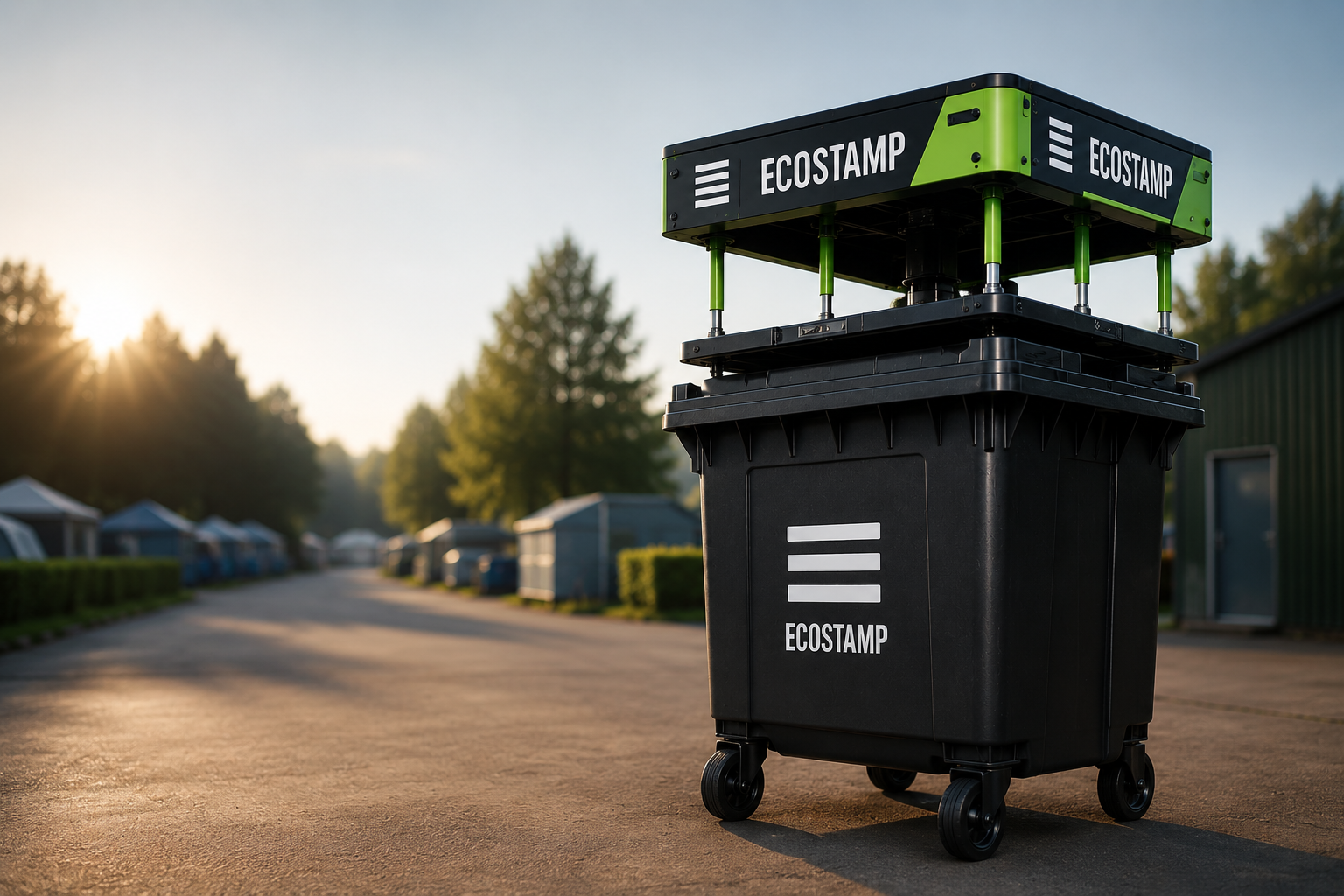
Portable concept
Designed around existing 1100L commercial bins
Additional uplifts may increase operating costs and create repeated vehicle activity around the site.
Untidy or overflowing waste compounds can affect customers, guests, neighbours and staff.
Hospitality, leisure and event sites can experience concentrated waste pressure over short periods.
The operating challenge
Some bins may reach practical capacity before their internal volume is used efficiently.
Some commercial waste streams contain voids, loose packaging and compressible material. In suitable circumstances, these characteristics may cause bins to reach practical capacity before their internal volume is used efficiently.
EcoStamp is being developed to explore whether controlled compaction within a suitable standard commercial bin could help operators contain more waste before the next scheduled collection.
The concept is not intended to replace the existing bin or collection arrangement. The current objective is to investigate whether a future engineered solution could work safely within the existing system.
How it works
Being explored around existing commercial-bin infrastructure.
EcoStamp is being developed to work with established 1100-litre commercial waste infrastructure rather than requiring replacement containers.
Position
The EcoStamp concept is positioned above a suitable existing commercial bin.
Compact
Waste is compacted within the container to explore whether its available capacity can be used more effectively.
Continue operating
The same bin remains part of the operator’s normal waste-handling and collection process.
Product concepts
Two concepts being explored for different operating environments.
Two engineering approaches are being explored. Final product format will depend on independent feasibility work, site requirements, operator workflow and safety validation.
Portable concept
Portable EcoStamp
A portable concept being explored for flexible, temporary and seasonal commercial use.
- Designed around existing 1100L bins
- Potential movement between suitable bins
- No permanent ground installation proposed
- Possible peak-period deployment
- Possible relevance to temporary and seasonal environments
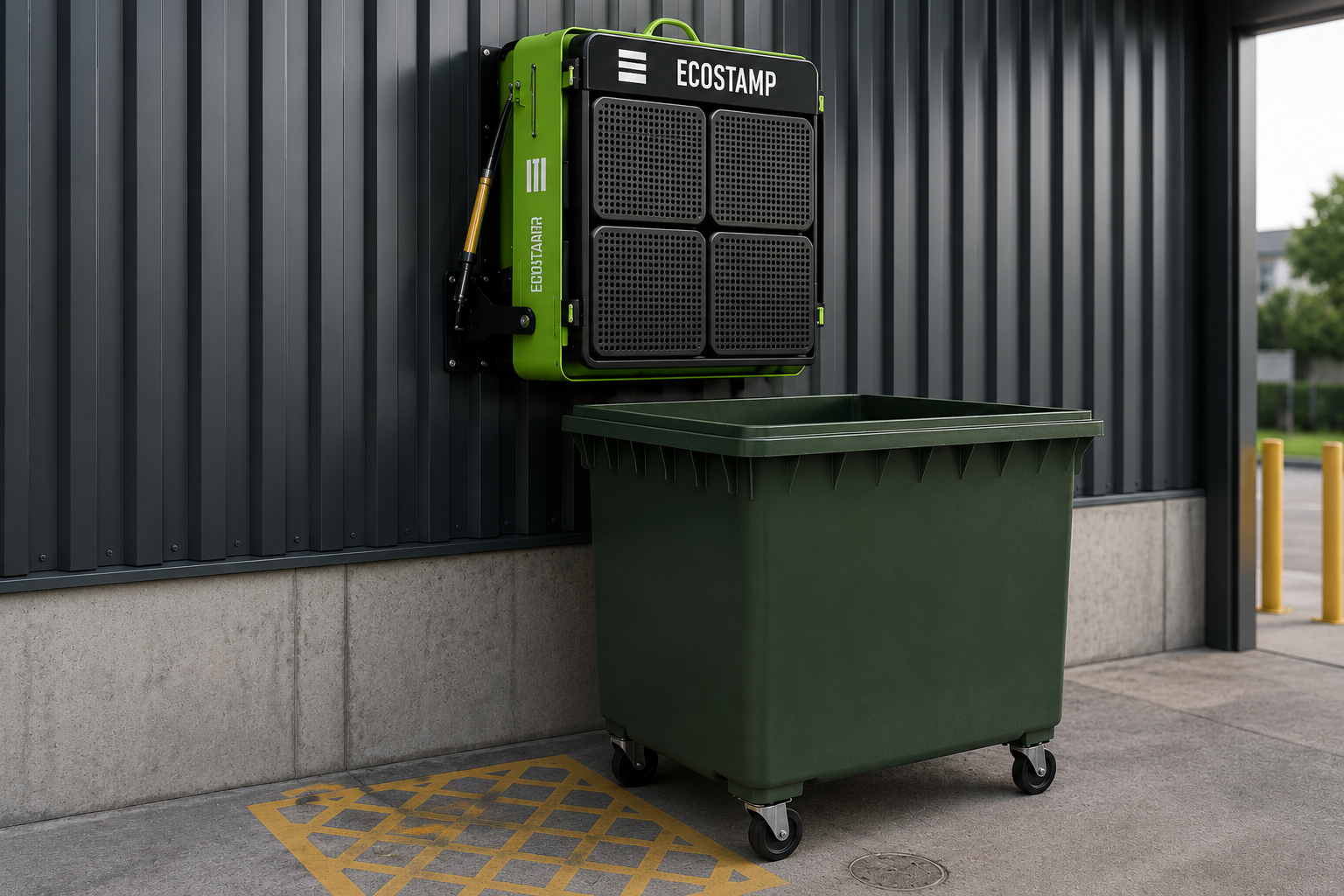
Fixed-position concept
Fixed EcoStamp
A fixed-position concept being explored for waste compounds with regular, repeated demand.
- Permanent waste-area positioning
- Potential wall-mounted format
- Designed for repeated operator use
- Possible compound integration
- Possible relevance to high-use commercial sites
Operational questions under investigation
Exploring more than collection cost alone.
These outcomes are not established product benefits. They are operator questions that future engineering work and measured pilots would need to test.
Bin-utilisation assessment
Explore whether existing bin volume can be used more effectively before collection.
Collection-pressure assessment
Assess whether a future validated solution could affect additional peak-period or emergency collections.
Waste-area management assessment
Investigate whether a future validated solution could affect visible overflow and waste-compound management.
Operational cost insight
Use the operator's own information to review bin capacity, collection frequency and current site waste costs.
Initial operator-discovery environments
Where EcoStamp is being explored with operators.
Early operator discovery is focused on commercial environments where occupancy, footfall, packaging volumes or seasonal demand create repeated pressure on standard waste infrastructure.
Hotels and restaurants
Sites generating regular food, packaging and guest-related waste.
Holiday parks and campsites
Locations managing fluctuating occupancy and seasonal collection pressure.
Festivals and temporary venues
Environments where waste volume rises quickly during concentrated periods.
Shopping and commercial sites
Multi-tenant or high-footfall sites using shared commercial waste infrastructure.
Workshops and business estates
Commercial environments producing packaging and general waste across repeated working cycles.
Multi-site commercial estates
Operators reporting similar waste-management pressures across several comparable locations.
Development pathway
From operator discovery to measured pilot validation.
EcoStamp is progressing through a staged process designed to answer technical, safety and commercial questions before any wider deployment.
Current
Pre-feasibility and operator discovery
Understanding real-world waste challenges and defining engineering
requirements.
Next
Independent engineering feasibility
Assessing technical viability, safety requirements and potential
implementation routes.
Then
Alpha prototype development
Designing, manufacturing and testing an initial working prototype.
Later
Measured pilot validation and scale preparation
Collecting operational evidence in controlled commercial settings.
Early concept development
View early concept-development footage.
Watch early demonstration footage illustrating the current concept direction and its proposed relationship with a standard commercial bin.
The footage may include historic or early-stage prototype material and should not be interpreted as independently validated commercial or operational performance.
Initial operator discussion
What we would need to understand about your operation.
An initial conversation would focus on practical site information, current collection arrangements and the operational challenges you experience.
Number and type of commercial bins in use
Current weekly collection frequency
Typical waste types and contamination considerations
Peak periods, seasonal occupancy and overflow frequency
Waste-compound layout, access and operator workflow
Current collection charges and additional uplift costs
Operator questions
Frequently asked questions.
Does EcoStamp replace our existing commercial bins?
No. The concept is being developed around suitable existing 1100-litre commercial bins rather than as a replacement-container system.
Does the calculator predict EcoStamp savings?
No. The calculator establishes a current collection-cost baseline from user-entered information. Any optional percentage comparison is selected by the user for sensitivity testing and is not an EcoStamp performance forecast, guaranteed saving, ROI claim or measured pilot result.
Would EcoStamp work with every type of waste?
Suitability would depend on waste type, contamination, density, safety requirements and the final technical specification. These factors must be assessed through engineering feasibility and site-specific review.
Is the portable unit already commercially available?
No. EcoStamp is currently at the pre-feasibility and early commercial-validation stage. Engineering feasibility has not yet started.
Could it be used across several bins or sites?
Flexible deployment is one possible design route being explored for the portable concept. Handling, compatibility, weight, stability and safety would all require independent engineering assessment and validation.
What happens after an initial enquiry?
The first step is an operator discussion covering your bins, waste type, collections, site layout and peak-period challenges. This helps determine whether the site could contribute useful evidence during future development or pilot stages.
Operator discovery and future pilot discussions
Could your site contribute to the next stage of EcoStamp?
EcoStamp is seeking practical feedback from commercial operators. Suitable sites may later be considered for structured assessment or measured pilot activity, subject to engineering feasibility, safety review and agreed pilot criteria.
An enquiry does not create a commitment to purchase, pilot or deploy equipment. EcoStamp is not yet commercially available.